Showing posts with label Op/Ed. Show all posts

Monday, March 11, 2013

Dream Chasers v1.0

[Ed. Note] This article was written by Game Creator's Vault founder and video-game industry professional Mark Soderwall.

Mark Soderwall speaking at the University of California Irvine.
A fairly common question I get asked after lectures and presentations I give on game-design best practices is How to stay so passionate or positive in an industry that usually presents dream chasers more closed doors than open. Do I take Zoloft, or is my ignorance really  bliss?

Absolutely NOT!

My excitement and head-down resolve stem from not only my industry experiences working in both large AAA and small Indie studios, which helped me to better appreciate the reward of it all, but also in the understanding of how I can get paid in doing something I'd otherwise be creating in my own free time!

Like anything worth fighting for, getting into the game-dev industry is just that, a fight.

Trying to invent new ways of staying positive every day through the relentless portfolio updating, rejection letters (yes, even professionals get them), hours of researching studios hiring and self-publishing developments is always a great challenge. However, what doesn't kill you makes you stronger and better prepares you for the next round of challenges!

Persistence is the key ingredient as well as timing in realizing opportunity. The day you blink your eyes open in the morning and choose to stay in bed is the day an opportunity may slip past you.

Every day is an opportunity to win, as well as lose. It's in the losing, though, that (most of the time) your character and resolve get tested and your ability to overcome adversity grows.

Continue to fight and muster up the resolve to constantly plow through the hard experiences of the day! Understand that your next opportunity may be waiting just around the corner, even if that corner takes days, weeks or even many months to round. Just don't give up, don't give in! The moment you settle for mediocrity is the moment life grabs you by the throat, wrestles you to the ground and sits its fat @ss on your chest! Fight through it and understand that while it may be a challenge, your character, portfolio and resolve will grow more competitive if you choose not to throw in the towel or tap out.

I understand that this sounds like a motivational speech. That's good! Sometimes we need to hear a good speech to warm up our heart and steady our resolve after it has grown cold in a wasteland of frustration and self doubt.

Mark lectures at an industry conference on game-development best practices.
The greatest thing to appreciate is that it's always a choice. You get to make one every day, for better or for worse. It's up to you. So what are you going to choose today?

As always, I, along with others, are here to help mentor and encourage you with our experiences, insights, best practices and networks.

If you really need advice or a good sock in the arm to you shake off your frustration, email me and I'll walk you through it!

Remember, it’s not only your talent and resolve that gets you over the next hurdle and into success, but the relationships and networksyou foster today and tomorrow that you'll take with you through your next challenge and career pursuits. You're never alone, or at least you shouldn't be!

Thursday, February 21, 2013

PlayStation 4: Next-gen is right now


Sony unveiled their next-generation gaming console, the PlayStation 4, yesterday at an event held in New York City.  The event can be watched in its entirety over at the PlayStation Blog.

The console itself was not actually shown at the event because it's final design has not yet been decided on, according to statements made by CEO of Sony Computer Entertainment of America Jack Tretton in an interview with AllThingsD.

I’m impressed. It’s a solid system with nice specs and some nice features like simultaneous downloading and playing. The instant on and off feature is cool too. Most of the really neat features require a constant internet connection and power supply though, which wouldn’t work for me because I always unplug my consoles when I’m done playing.

I’m wondering why they held an announcement event for the console before the console itself was actually finalized and ready to be shown. I’m afraid that the industry has come to a point now where content creators are too willing to sell promises that sometimes go unfulfilled.

When Nintendo first announced the Wii U in 2011 and only showed the Gamepad, most people – including those of us at E3 – were not sure exactly what we had been shown. Now, Sony announces the PS4 and only shows the Dualshock 4 controller. I’m not comparing Sony to Nintendo exactly, because Sony did give detailed specifications and real-time demos, but it’s still a trend I’m not totally comfortable with.

I think that interconnectivity between devices is certainly the way of the future for the games industry, and Sony is right on the money with their focus on sharing and connecting between players. The ability to stream gameplay and spectate friends' games will likely be strong selling points for the PS4 because it brings back a sense of community that has been hard to regain since playing with friends in the same room has become more and more rare.

PS3 titles like "Journey" won't be natively playable on PS4.
The really major thing that irks me is that the PS4 will not be backwards compatible out of the box and Playstation Network purchases will not transfer from PS3 to PS4, Present of Sony's Worldwide Studios Shuhei Yoshida said in a roundtable discussion with journalists after the PS4 reveal event. Gaikai should solve that problem by streaming previous PlayStation titles to PS4 over the Internet, but it’s not guaranteed and it likely won't come at launch.

All of this – social features, Gaikai streaming, sharing and the like – completely alienates anyone without a regular connection to reliable internet, and, to some degree, people with internet data caps. I guess that’s the way of progress, though. Xbox Live used to be an optional feature for those who could afford it, and now it’s practically assumed to be as much a part of the gaming experience as a disk drive.

Of course, it's still very early to be making sweeping judgments about any of the next-generation consoles, so when more information becomes available we will all be able to decide for ourselves whether the future is bright for the industry.

Saturday, October 27, 2012

From reporter to salesperson: the potential fall of games journalism

 [Ed. note: this article has been edited to remove an error of fact.]

Games journalism is a scary place to be right now.

Not in the sort of way that makes hopeful writers run away and choose a new career, but in the way that makes trained writers uneasy and question what it is they do with the words they write.

Robert Florence, a columnist for Eurogamer, wrote an editorial piece on Wednesday criticizing some of the behavior of his fellow games journalists. He noted that some bite quite regularly at the chance to win free games, consoles and other merchandise from PR representatives out of various development houses, particularly in a contest held on Twitter.
This is the image that drove Florence to voice his controversial opinion.

I must admit that I am guilty of the rush for swag at the Electronic Entertainment Expo, Comic Con and other such conventions. I also accept the criticism that participating in that type of behavior brings, and have been stirred to rethink what it means to be a games journalist.

It is the duty of a journalist in any field to report the news, and in our case critique art, and remain objective above all else. Going to E3 and snagging a bunch of free lanyards and flash drives branded with “Call of Duty: Modern Warfare 3” on them and then writing about what a great demo the game had is not a perfect example of journalistic integrity.

Sometimes it can be very difficult reporting on video games without being influenced by PR reps because those are the people that deliver information to press from developers. 
Games journalists don't call up Ken Levine or Cliff Blezinski and ask how the latest project is coming along. A public relations expert compiles the necessary information for optimum potential audience excitement, and they tell these figureheads of big games what they can and cannot say to which media outlets.

Now that the Internet has made it so simple for so many avid gamers to become freelance games journalists, and a select few have garnered enough of an audience to warrant the stream of free games and swag from PR teams, it seems to have turned into a mad dash to fluff up the most popular games in an attempt to get free stuff.

I'm just afraid that video games journalism in on its way to becoming the largest public relations effort in recent history. A branch of journalism that serves only to hype and fluff, and never to call out or criticize.

It's important for those of us writing about these games to remember that journalism is not gushing about your favorite franchise and talking trash on those games you don't like. And the ability to spell and form grammatically correct sentences is another important requirement that many seem to forget.

Let's not sell the games we love. Let's not let ourselves be used by the people helping to create them. Let's use our voices to make the medium better by saying what is true, and not what is expected.

Wednesday, August 29, 2012

How do you sell a problem like Next Gen?

Games Industry International had a really poignant article written by Johnny Minkley that really began to dissect the next gen launches of previous systems and what might be necessary to sell the ever looming new systems on the horizon.

The article mentioned, of course, how tired consumers are getting of the current gen systems and the cyclical money machine that the industry has become. Whatever the next gen systems are like, Minkley hit the nail on the head when he said that "the first thing to say is it had bloody better be a 'quantum leap' from the creaking innards of today's systems."

A quantum leap would be nice. More processing power, graphical capability, memory and refined tech could really help those suffering from constant Red Ring fear. Not to mention some tighter online security. Yes, Sony, I'm looking at you. But even shiny bells and whistles will not really "sell" the consoles to consumers. Sure, people will buy the systems out of habit, but will we really see them as the next gen that we've been waiting for?

Minkley said "looking at every single launch title across PS2, Xbox, Xbox 360 and PS3, I see only a single, clear system-seller in there: the original Halo." I have to agree with him, despite my own indifference to the series. When "Halo" came out with the original Xbox system, that was what I associated Microsoft's gaming platform with, "Halo." I couldn't for the life of me tell you what came out with the PlayStation 2, and the only thing that stuck out for the PS3 was "Uncharted" due to its graphical glory and interesting story. The Wii, obviously, was heralded in with "Red Steel" and other such failures, much to Nintendo fans' dismay.


Remember this? Of course you do.
"Halo" stands strong as a game that really sold a system though. You could only play it if you had an Xbox and therefore, you needed one. There are some folks who never upgraded their Nintendos, PlayStations, and even Xbox's, but merely moved from one system to another's more advanced counterpart. We all know that person who has a PS2 and an Xbox 360 or that one guy that still has his Xbox but seven thousand Sony titles to fill his time on his PS3.

But hidden in the middle of the article and a little at the tail end is the real point that Minkley nailed. Microsoft may pull ahead if it begins to make deals with cable providers and offer some sort of package deal with the new next gen Xbox's to give television as well as gaming. This would be a brilliant move and that kind of diversification of tech is what is selling most frequently these days.

Many bought a PS3 solely due to the fact that it came with a Blu-ray player installed in it. Even Blu-ray, though, had difficulty achieving widespread success. Had it become the dominant form of in-home digital media, the PS3 would have trounced any sort of effort by Microsoft or Nintendo, simply because of the system's versatility.

Next gen systems may begin fighting to provide the consumer with a jack-of-all-trades rather than a quality gaming experience alone. Personally, this makes me weep for the future of gaming if we're just trying to make compact computers that display on televisions rather than machines built to provide us with the most streamlined gaming experience we can. Really, that's what these machines have become, and if I had wanted that I would have just upgraded my PC over the years and not cared about getting a system at all.

Minkley says that the war might be fought over contracts and who can give us more bang for our buck when it comes time for release. I think he's right. What the fight should be over, though, is who can make the next "Halo" type game and really make something that draws people to buying the system rather than just giving us a load of expected next gen titles and then waiting a year for something truly special.

Wednesday, August 22, 2012

PS Vita sales disappoint at 2.2 million units worldwide

I can't think of a single person who was actually excited about it.
According to a recent article from Edge, the PS Vita is being outsold by its predecessor, the PSP, by almost two units to one.

This really isn't a surprise to anyone since the portable system has been abysmally received in Japan and had one of the worst releases in America compared to any other handheld. Granted, the Vita probably had more commercials than the 3DS, and is more versatile and technically impressive, but something just doesn't seem to sit right with consumers.

In my article reviewing the Vita I stated that there really isn't anything wrong with the system per say. Really, the issue becomes the purpose and need for use of it. For the price tag, $250 new (I'm sure you can go to any game store and buy a used one), it makes sense. There is a whole lot going on inside of a PS Vita. The dual touch pads, high powered graphics, game types, music capabilities, movie capabilities, camera and WiFi connectability are all equally impressive and functional.

The problem arises from need. Gamers are really having to ask themselves if they really need this device. After all, it's literally a portable PlayStation 3 system and one of the big draws is being able to continue playing games off of your PS3 onto your Vita should you have to leave the house. Obviously, there aren't enough people interested in doing that at all.

When it comes down to it, a handheld system's strengths are in the ability to entertain for a few minutes up to an hour or so, then be put down. That's how Nintendo has done it for years and continues to succeed. The games on a GameBoy or DS were always ones that were easy to pick up, but satisfied you enough after putting them down a few minutes later. "Pokemon's" entire appeal is that it has the combat and adventure feel of "Final Fantasy" with a lower level of involvement. Sure you could spend hours on the game training and whatnot, but you didn't have to in order to have fun.

I mean, it looks fun.
The games so far on the Vita (we've done at least three reviews so far) have been good games. However, the best of them were the fighting games because really, that's the best example of the Vita as a handheld. "Uncharted: Golden Abyss" was an amazing game. However, the amount of attention and invested time to play it is too great for it to be a game you play on the go. So if you're not playing it out and about, but rather at home, there's no reason to play a PS Vita on a couch when a PS3 is there with all three "Uncharted" games.

Then there are the multimedia aspects like the camera, videos and such. With all the portable technology that is at the disposal of consumers in regards to tablets and even phones, there's no need to buy another gadget that has the capabilities that previously owned tech possesses.

The fact is that the Vita came too late to the party. Much like that friend who brings a six-pack of beer when everyone's already moved on to mixed drinks and hard alcohol, Sony brought something useful and competitive to the table, but consumers have just moved on. And for the price tag, it just doesn't seem worth it to even try it out.

Monday, August 20, 2012

The fine line between spin-off and stand-alone


With games nowadays reaching their third & fourth installments or so in their respective series, it’s safe to say most have had their own spin-offs. Some are good and essential to the series and others are better left alone. Sometimes these games, whether good or bad, get mixed in together and because of that some people would rather not deal with them and just wait for the numbered games in the franchise to come out. That's not good and I believe that the lines between pin-off and stand-alone game should be made clear.

To me, a spin-off is when the gameplay itself has been reworked to make a brand new game which offers a different experience than what the franchise is used to. An example of this is “Super Mario”. Mario's done everything from sports, racing to partying. He's a regular jack-of-all-trades. His regular forte is either a side-scroller or an adventure game, but being pushed into these other games have left some pretty distasteful titles in his name. Then again some of the spin-offs have gone to make their own franchises like “Mario Kart” & “Mario Party” reaching the 7th & 8th installment already. Other famous properties have gone on to try and do this as well and a majority of flak from a game being dubbed a Spin -off comes from it. Games like “Sonic All-Stars Racing” and “Donkey Kong Konga Beat”. All of these have no relation to the main games but bring the series down in fans eyes.

Crisis Core was a necessary game but was received as just a spin-off
Now there are some games that really shouldn't be classified as a spin-off. Take the “Kingdom Hearts” series. There are six games in the franchise but only two of them hold a number. The others are spread out among various handhelds. While some would call them unnecessary spin-offs, these games are a very integral part of franchise. For example, if players hadn't played “Chain of Memories” on the GameBoy Advanced then players would be lost on what happened between “Kingdom Hearts 1 & 2” and not understand how a majority of the plot points came about in the sequel. In short, they'd be lost as all hell and the same can be said about the recently released “Dream Drop Distance.” If fans don't play that then they're lost on what will happen in the next game.

Spin-offs can also serve as a way to tell part of the story that couldn't be put into the game due to time issues or development issues. “Final Fantasy VII” was a great game with a great story but one big plot-hole was who Cloud's mentor Zack was. He was only brought up in the game for a small portion but he was the person that Cloud had molded his life around. Several years after the original game had come out, Zack's story was finally revealed in the PSP's “Final Fantasy VII: Crisis Core”. The game was labled as a spin-off but both the gameplay and the story made the game a stand-up title to be heard in the franchise. From the beginning, you knew what Zack's fate was but the story made you forget that and focus on what was happening at the moment. It’s these kinds of games that the title "Spin-Off" should not be applied to. These surpass that title and should not be brought down by it.

Games in which the story of the series are kept and added to should not be considered spin-offs. These need to be acknowledged as games that should be played and loved. Not as optional, random whims. Hopefully by now people will see the difference between the kart racing gaming and the heart wrenching story of a character.

Saturday, August 18, 2012

Historical settings in games: what works and why

Let's go back in time. Back to when the Nazis were still an international threat, when the holy land was fought over by crusaders and jihadists, and when Los Angeles was still riding the wave of Hollywoodland's star power. No matter where we go, who we are or when we are, games that take us through the Time Vortex like Dr. Who on a whim always fascinate us.

Playing as a soldier doesn't always feel like being a soldier.
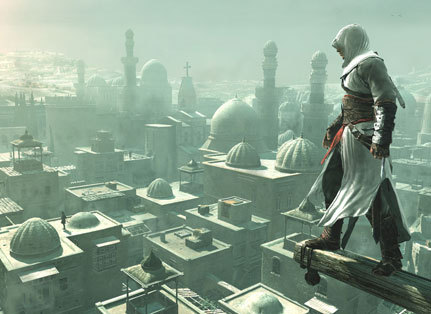
From "Call of Duty" to the "Total War" franchise, games that use historical time periods as their setting tread a fine line between reality and poetic license for entertainment. Kratos's exploits work wonderfully because they work within Greek mythology rather than weaving him through events in Greek history. Perfect. Whereas Ezio and Altair of "Assassin's Creed" meet major players in history but rarely effect the course of well-known fact (minus the Borgias, of course).


The key is immersion. What can the developer get away with and what can they bend without the player losing immersion. To properly immerse a player in the idea that, yes, you are back in time and this is how things are, is much harder than one might think. There is a lot of preparation and set dressing to do before the game even gets underway.

A lot of research must be done to properly understand the clothing, jargon, languages and proper cultural nuances that must be layered into the game world. Now, no one would really bat an eye at the Nazis shouting in English with German accents, but it is more frightening to hear a foreign language shouted at you and not know what it means.

Eventually, you feel proud of yourself when you pick up terms that you know mean "grenade" and the like that help to fight back more effectively and dodge appropriately. That's exactly what our soldiers have to do in war when they fight against a foreign enemy.

 Let's not forget the weather of France and the flowing language plastered all over buildings in small towns to really make you feel you are in a foreign land fighting against a foe that you can't understand. Though, apparently every American soldier is from the southern U.S. or grew up in Brooklyn.

Some war games like to put you directly into battles that really happened, and this is where it gets tricky. "Call of Duty" seems to do this very well by making you accomplish goals that aided in the battle's completion. Or, as in "Black Ops," they make you experience the fear and terror of Khe Sanh, while not putting you in some sort of position that would change the course of the battle just for the sake of playing in it.

He can see his house from there!
Then there are games like "Assassin's Creed" which put you directly in historical settings with important figures.

Now, since the franchise establishes that there is a sci-fi element to it, and that the whole premise is that history may not be what is written, they cleverly avoid having to stick to historical fact too much. Yet, they use immersion.

In the "Assassin's Creed" games, half of what you hear on the streets of Jerusalem is incomprehensible if you don't speak the language, while in Rome the streets are flooded with shouting in Italian. Even Constantinople has a mix of languages to really set the tone.

The colors used, landmarks, buildings and clothing cement the location. Not to mention the ability to visit historical monuments and climb all over them. Even though the game mucks with historical fact here and there, it really does rely on being grounded in history to provide an enjoyable experience for the player.

But what about games set in a well known time period and location while also using fictional people and places? Look no further than "Red Dead Redemption" and "L.A. Noire." New Austin clearly isn't real, but it felt just as beautiful and weather-beaten as any other part of the West during the Expansion Era of the United States. Even the region of Mexico that John Marston travels to is believable, though not all of Mexico was full of bandits and tyrannical colonels.

Then there's Cole Phelps and his descent into the gritty underbelly of Hollywood. Of course, using real studios was out of the question, but putting fictional ones seamlessly into the iconic Los Angeles landscape was simple enough and downright convincing. Having a shootout in an RKO-esque movie set, car chases through greater LA County streets and searching for clues in back alleys all sold the setting.

The streets of Armadillo are paved with dead gunslingers.
We love going back in time. It's why we go to movies and read books and play video games. The times we really enjoy it, though, are the times when we believe it - the times we're truly convinced we are seeing or experiencing an event from the past.

 Even if something about the game is far fetched, like flying through the Venice skyline on one of Leonardo da Vinci's flying machines, we still feel as if it's Renaissance Italy. Even if you take over the Roman empire as Carthage in "Rome: Total War," you believe it's possible using the historically accurate troops and tools of that time period.

The name of the game, ladies and gentlemen, is immersion. Say, that might actually be a pretty good game title. Anyone want to help me make it?

Friday, August 17, 2012

Mobile games designed for TV


Why are we waiting for the Wii U to come out when we already have it? It’s called AirPlay.

The latest versions of Apple’s iOS supports a technology that allows you to display your mobile screen on the TV. Hooray! That means PowerPoints for everybody! Not exciting you? How about games, then?

The comparison between AirPlay and Wii U may have been a bit of a stretch, but the technology still presents an interesting opportunity for game developers. Anyone who has an Apple TV can share their iPad’s display over WiFi to be displayed on the TV. For games, AirPlay can take it one step further and allow you to display something different over the TV than what’s being shown on the iPad screen. In practice, this means you can control your character on the TV while having your dashboard controls on the iPad, touch screen and accelerometer included.

Who could forget this little gadget?
The concept of a TV game being controlled by mobile devices isn’t new. We’ve been able to do this in the past with the Game Boy Advance Link Cable (remember "The Legend of Zelda: Four Swords Adventures" or "Pokémon Colosseum"). Downfalls included a limited title selection, still having to have a dedicated console and being limited by the Game Boy Advance controls. Today’s technology combination with accelerometer sensors, wireless multiplayer and high-resolution displays have created the perfect storm that could really let this idea grow.

Multiplayer is where AirPlay could really shine.

Being able to have four or so iPhones connect to an iPad, having the iPad project something on the screen and having the individual controls be on their respective devices could lead to some pretty innovative games. Anyone who has played the Wii U can instantly make the connection between what AirPlay games could be and the direction that Nintendo is going with their games.

Testing out the games currently available in the market shows huge room for improvement. Many of them suffer from lag issues, general bugs (why is my place flickering!?) and don’t truly take advantage of all the different gameplay methods AirPlay allows for.

Higher performance games create some issues too. The iPad does have the ability to render some pretty great looking 3D graphics, but adding AirPlay to the mix adds a lot more work for the processor. It needs to render the game’s graphics, then compress the image and send it over WiFi to your router and then your Apple TV in real time. This means that right now, expansive worlds with elaborate 3D graphics may not be the target game for this platform.

Apple’s devices aren’t the only place where this is happening, either. Ouya is an Android based game console that’s currently in development, and while it takes a different approach to gaming by building the actual system in to the device connected to the TV (where as the Apple TV only acts as a dumb box to display what the iPad is feeding it), it could very easily integrate Android-powered controllers and take advantage of the same multiplayer, accelerometer and touch-screen goodness.

One of the great things about the expansion of mobile devices as a viable gaming platform is that the barrier to entry is so small that pretty much anyone can just start making something. The problem before was that your creation was just stuck on an individual device with a 3” screen. AirPlay and other implementations of it really allow anyone to develop games designed for TV just like the bigger consoles.

Thursday, August 16, 2012

Tablets. Who knew?

Are tablets the future?
It seems in the past few years, that mobile devices with touch screens have been on the rise. From Android devices to the iPhone, everyone nowadays has one, and, because of that, mobile gaming has become more prominent.

But bigger is always better, so tablets were made. Okay, so maybe the tablets weren't specifically made for the mobile gaming group, but they did have them in mind. So much in mind that at this year's E3, tablets and mobile devices had a big presence on the show floor.

Companies like Gree held a huge part of the floor showing off their new games and applications for various devices including "Farmville"-esque building games and “Resident Evil: The Mercenaries VS,” some of which are exclusive to the larger tablets. With what’s already on the iTunes App store, tablets are slowly starting to take over mobile gaming as a whole.
Mobile-game developer Gree at E3 2012.

The tablet’s success can be drawn up like this:

Mobile gaming previously involved just having a Gameboy in your pocket and being able to pull it out whenever. Now, convenience has become a bigger issue.

Why have a brick of a Nintendo 3DS in your pocket, only meant for playing games, when you can have a thinner iPhone which can be used for practically everything? You can be sitting at home working on something on your tablet and with just a few taps of your fingers you can be playing "Tetris."

It’s a big thing to be able to do that when in the past you'd have to change a disc or cartridge.

Consumers aren’t the only ones who've noticed this. Big name gaming companies have too.

The PS Vita could help bridge the gap from tablet to handheld.
It can be argued that Nintendo was the first to start the touch era, but it’s pretty safe to assume that their new console, the Wii U, has been at least ever so slightly influenced by the tablet craze. I mean the controller is basically a tablet with thumbsticks and buttons, and, to tell you the truth, it actually works. But for more on that, go check out Mike’sopinion of the Wii U.

Sony is also taking part in this trend. With the PS Vita having the dual touch-screens and all the similar capabilities of a tablet, it’s not a far cry to say that this handheld was made to appeal to both tablet users and handheld gamers. Like I said earlier, it’s all about convenience.

With these options, people who are on the fence about either getting a tablet or a gaming device can now have both in one, and this is what the companies are aiming for. To bring the core gamers and the casual gamers to one device that everyone can enjoy.

Now the question whether tablets are the future of the gaming industry or just a fad. My personal opinion is that maybe it’s here to stay. Most people already have a tablet device that they can play games on. It's unlikely that people will want to shell out another $200 for a Nintendo DS when they already can play a touch screen game on their phone. That’s why so many companies are coming up with more mobile games and platforms that seem similar to the tablet.

There is a difference, though, if you play on a tablet and a handheld system. Most people who play on a tablet only intend to play for 5 minutes or so as a way to kill time. A handheld is meant to be an activity, spending hours and hours playing, but this could all change soon enough with the growth of the PS Vita and Wii U.

Wednesday, August 15, 2012

What mobile apps can learn from games

The iTunes App Store, Google Play and other markets have given us reason to never let go of our phones as we use them for everything from keeping our appointments to hurling angry birds at pigs. If I asked you what your favorite app to use is I can almost guarantee you it would be a game. Why? Because even while you may use your calendar religiously or always be Instagram-ing your food, your utility apps (let’s call them that) are downright ugly and sometimes a pain to use.

Last month I took a trip up to Silicon Valley, a place widely regarded as the home of technological innovation, and had a long talk with a couple of entrepreneurial strategists about the interfaces used in utility apps today. We were talking about how both mobile and desktop utility applications that you see today are ugly, slow, and clunky.

My 4-year-old cousin can pick up my iPhone and immediately start playing "Annoying Orange" but my mother on the other hand holds on to her dumbphone because the cryptic icons and gestures of the latest smartphones don’t make sense to her.
I wouldn't touch this software with a ten-foot pole, let alone my finger.

Apple, as much as I love them, even seems to encourage a cookie-cutter type of app for their iPhone. Their Xcode tool gives a simple drag-and-drop interface to create user interfaces (UIs) that trap a developer eager to get their app to market into creating a subpar, boring UI that requires a manual (or makes you wish you had a manual).

Android gives more control to the developer, but that often results in the age-old problem of an ugly interface that screams engineering degree. No offense to those engineers who also have good design intuition. I know you exist too.

So here’s my point: what if we stopped thinking about utility app development from a boring, “this is an app to do work,” mantra to a more game-like point of view. Before you think I’m trying to turn everything all "Fruit Ninja" on you (although, you might like that), hear me out.

Game UIs are less restrictive. Maybe having that back button shoved in the corner of the top navigation bar isn’t the best place. Heck, maybe that top navigation bar needs to disappear altogether. Game designers are rewarded for making designs that don’t stick to a cookie-cutter style while utility app designers are punished for not being consistent.

Game UIs communicate more information using less screen real estate. The heads-up display in "Diablo III" relays more information in a smaller space than any office application I’ve used.

They also communicate that information more fluidly and less-intrusively. I hate how I have to switch windows or even spaces just to respond to a simple text or instant message. Games typically make use of windows with different opacities to attract focus.

Game UIs are easier to use. When I ask my game-shy friends if they want to play a game, the usual response is that they’ll watch me play for a little while and then give it a shot. When they pick it up, it all comes fairly easily because the game teaches you as you play.

Games are that easy to use because players have demanded an experience that doesn’t require them to read a manual. Game developers have already faced a lot of UI design and human interaction problems, and have fixed them (well, the good developers have) while standard utility-software development has been stuck thinking inside a box full of restrictions and standards.

Tuesday, August 14, 2012

Rely on your squad

It's tough being a squad leader, isn't it? What with having to make sure your team doesn't suffer critical damage, ordering them around and fighting enemies things tend to get a little hairy. What doesn't help is if your squad is as dumb as a sack of Deku nuts.

Squad-based gameplay has taken some leaps and bounds in the last few years, and some tragic and hilarious crashes. Everyone remembers games like "S.W.A.T." and the original "Rainbow Six" that had artificial intelligence that was just okay. Then there are games like "Skyrim," in which your companion character's battle tactics are sometimes the subject of horrific ridicule. Oh, Lydia, will people ever forgive you?


Then there are games like "Ghost Recon: Future Soldier" that really surprise you with how good the squad is and actually make you excited when utilizing their abilities. When the squad actually does what it's told and you can rely on them, you tend to enjoy the mechanic rather than loathe it.

What is the key to this, though? Why is "Ghost Recon: FS" so much better with squad AI than "Mass Effect?" Perhaps it is the design and purpose of the squad itself.

In games like "Halo," "Mass Effect" and even "Dragon Age: Origins," your squad is meant to supplement your playstyle and abilities. Instead, your marines end up getting in front of you or holding better weapons. Or Morrigan will stand her ground in front of a horde of Darkspawn rather than run or cast a large AoE spell. And let's not forget Liara just sort of sitting there instead of tossing her biotic powers willy-nilly at Geth to help even out the playing field.

Luckily, in "Mass Effect" and "Dragon Age," you're able to pause the game and tell your squad where to go and to do certain things to avoid outright death. Frankly, telling them what to do actually makes them more effective in the first place, and one wonders why they're AI controlled at all.

Sometimes it's almost like they're just there to model their outfits.
Unfortunately, in games like "Halo" and "Call of Duty," you're left shouting "Why are you shooting at that guy two stories up and in cover and not the three people standing right in the middle of the road?!"

Games like "Ghost Recon: FS" make you weep with joy when you have AI that can lay down effective suppressing fire or actually take out an enemy that you tell it to. The big difference is that these AI characters are actually meant to be played by other human beings rather than just be a squad for the sake of being a squad.

Games like "Dungeon Siege III" prove this, too. Alone, with a single AI companion, you are able to go through the game rather easily with an AI character that can do the most area damage (rather than picking one that you feel will do precise damage) and wound everything enough for you to make kills quickly. Replace the AI character with three other human players and the team becomes an unstoppable cadre of magic, swords and guns. Honestly, it's something to try if you haven't played that game with other people. Again, these AI characters are made to be played by other people.

If "Dragon Age" had a cooperative campaign that allowed for online players to outfit and level the teammates accordingly to fit their playstyles or the style of the team, the game could be much more difficult but exceedingly more fun. Put in the dialogue system from "Star Wars: The Old Republic" and you've got yourself a game of the year.

"Halo: Reach" worked well enough when you play the co-op campaign, but other than that it feels like you're the only one fighting the enemy and the friendly AI is along for the ride. "Gears of War" co-op is also really fun to play and can be even more enjoyable than the competitive multiplayer (more enjoyable if you ask me).

When thinking about putting co-op in your game, don't think about doing it just because you've got a squad in your game and you want to capitalize on multiplayer madness. If a player can outfit and command the AI enough to where she's playing all four members of her team, then maybe you should think about implementing a co-op system to make it less challenging for them and promote teamwork. Maybe even give the players rewards for doing so. Whatever you do, for the love of Kratos, make the AI smart enough that they don't run four miles down a hill to attack a dragon you've been trying to avoid because you're too weak. Please, stop it Lydia. I love you, but stop it.
Probably one of the best and most challenging multiplayer experiences to date.

Monday, August 13, 2012

All together now: a look at micromanagement gameplay

A lot of games have you taking control of dozens - or possibly hundreds - of units at a time tasking you with overseeing them all like some omnipotent being from on high. Being able to move from one part of the map to another, then back to where you were to ensure your squad is not destroyed while you tell your peons to collect more gold has been a standard gametype and gameplay mechanic for years on the PC. Some might say that it has been used well enough on consoles with games like "Starcraft" and "Lord of the Rings: War of the Ring."

In "Pikmin 3" you'll get to choose specific areas in which to launch your Pikmin.
Few remember "Pikmin," though. One of the flagship titles of the now ancient Nintendo GameCube, it was quite possibly one of the most innovative and impressive titles to ever be a console launch title. The sequel, which was released in 2004, marked the last time we would see any of the adorable little plant-like creatures jumping on top of larger animals in a mass of color to overpower and destroy. No more would we get the pleasure of watching their flowers bloom to show their strength level, and gone were the days of enjoyable item collecting with the quirky little aliens.

Yet at E3 2012 the world was given a chance to once again return to the strange planet that fostered these adorable creatures.

In the eight years since "Pikmin 2" there haven't been many other games like it. The only one that springs to mind out of sheer similarity and startling hilarity has to be "Overlord" and it's own sequel. The game had players commanding minions of different color and ability and having them parade behind you until you thrust them upon unwitting settlers or elves in a cacophony of fire and Cockney accents.

The idea of commanding squads like this into battle is - as I said before - nothing new, but what is still fairly new is the idea of commanding them on the field of battle alongside your soldiers. Over the shoulder views can only grant you so much of a perspective as there still is no real danger to yourself. Squad-based combat systems like the ones used in "Star Wars: Republic Commando" and "Brothers in Arms: Hell's Highway" are closer to what "Pikmin" and "Overlord" achieve, though.

How many of you actually remember "Overlord?"
What I'm talking about is the idea of being in command of larger groups (20+ individuals) while still having to worry about your own safety and fighting the enemy with them.

"Overlord" allowed you to upgrade your magic and weapons so that you would truly feel like an all-powerful badass surrounded by scores of equally frightening critters. "Pikmin" was more toned down, but focused heavily on the strategic use of the Pikmin themselves whilst also protecting yourself from mortal danger.

In one word: Presence. That's what these games developed for the player, and that is sometimes what a game is lacking. The player often doesn't feel a part of the world, and there's no sense of danger or consequence when micromanaging. Just take the viewpoints as an example: over the top, distant, looking down on the action. "Pikmin" and "Overlord" put you toe-to-toe with monsters like other third-person role-playing games, but also gave you a ground perspective of the work you were having done. It's also a level of realism and survival that you normally don't see in a real-time strategy game.

Being present and aware of your surroundings while making sure something is collected. Constantly on the alert for what may lurk around the next corner, or what may even be stalking you at that very moment. That's good gameplay.

With "Pikmin 3" coming out for the Wii U, there's no doubt that the Vault will be taking a crack at it and seeing just how well Nintendo has perfected this style of gameplay.

When making your own games, don't forget about presence, and whether or not it matters to the gamer. See what you can do to make them feel invested in the environment instead of just the enemies and the goal. Make them fear for their safety as the character instead of knowing that if they just hide behind some rubble they'll be okay.

How much more dangerous and intense would any of the "Call of Duty" games be if you actually had to command the troops around you while fighting? What about leading troops into battle in "Skyrim?" Think about it.

Saturday, August 11, 2012

The E-lympics

I'm not sure Usain Bolt, the "Fastest Man Alive," holds his controller like that.
So, Kotaku posted this and the writer really spent a lot of time putting this article together about making a case for video games being in the Olympic games. It is an admirable effort and I applaud Kotaku's writer for really trying to do so much work, but no. I'm sorry, no. No no no.

Now, I love video games and I'm extremely ecstatic that e-sports are a thing now and are so popular the world over. That's brilliant and I'm happy. I really am. But as an athlete as well, having played basketball since I was six years old and then track and field until freshman year of college, I can say that the idea of a video game being an Olympic sport is just silly.

This is not to say that video games aren't trying and aren't competitive and that they don't show a large demographic from every country. That is totally true, I'm a gaming journalist and I know this. But, by saying this I am also saying that there are some sports in the Olympics that don't belong there as well and I have a hard time seeing those just as much as I do seeing video games there. But, going back to the Olympics at their core: running, jumping, throwing, wrestling and fighting. They're all physical tests of will and strength and athleticism. While some Olympic sports now toe the line on athleticism, others can have cases made for them.

To argue the point I'll look at Kotaku's points. "If shooting is a sport..." First off, anyone who has ever fired a gun in their life can tell you that holding a twelve-pound-plus firearm, aiming down the sight, bracing for the recoil and then cracking off the round is a physical and mental effort just as much as archery. Top marksmen spend their lives working hard at being able to hit targets that are being affected by the elements and working against a weapon that can also be inaccurate if the chamber and rifling inside the barrel is dirty.

Stephen Totilo, the writer of the article says, "while they may not involve running fast, jumping high, or even that much sweating, the one-on-one virtual combat of Street Fighter or the simulated clash of futuristic armies in StarCraft require a dexterity with a fighting stick or mouse that certainly exceed the muscular dexterity needed for the non-Olympic sport of competitive eating but maybe, possibly as much as is needed for the Olympic sport of competitive shooting."

Totilo makes a point that the finger dexterity of using a fight stick is quite possibly Olympian. I'm sure Clockwork of the competitive "Marvel vs. Capcom" circuit could attest to that. But the Olympics is about sports that everyone can do. Everyone has guns. Not everyone has a fight stick. Now, does everyone have a javelin or pole with which to pole-vault? No, but they are accessible and able to be worked with in school for most major countries for the exact reason that they are in the Olympics.

Next Totilo argues that since chess lobbyists are working hard to get chess into the Olympics, then video games might have a case too. No. There's a reason chess isn't in the Olympics, just as there's a reason golf will never be in the Olympics. While they require skill, they require intelligence and are clear competitions, they don't quite make it on the list of Olympian sports. Perhaps it is because when you think of an Olympian you think of someone fit, someone who is the best specimen of health and athleticism from a country (which could say something as to the possibility of perspective being the only reason sports are allowed to be Olympian), but you don't think of certain competitive golfers or chess players as Olympians.

This actually happened. Seriously.
A sport that is just like these that doesn't belong in the Olympics? Table tennis. That's right, I said it. What in the name of Zelda's ocarina is table tennis doing in the Olympics? Tennis I understand. Table tennis? That's like when power walking was in the Olympics. I'm lookin' at you, Beijing. I could hardly believe it. Oh yeah, that happened. They called it race walking. Don't believe me? Check it out.

So, I get it. I get there are things in the Olympics that justify putting video games in them. I totally understand it. However, look at the X-Games. Those are very athletic, very dangerous yet extremely skillful men and women who aren't allowed to compete in the Olympics because their sport isn't considered Olympian. What happened? They made their own competition that happens every year. This might be the answer for video games: The E-lympics.

I can't believe I just wrote that because it sounds horrible, but you get the idea and someone else can come up with a better name for it. This can be the place that the competitive fighting game players who absolutely destroy each other in "Street Fighter" and "Marvel vs. Capcom" can get nationally recognized. Those geniuses at "Halo" multiplayer will have a place to shine. You really want to show off your "Dance Central" skills and say that you can get a perfect on the hardest difficulty? Welcome to the E-lympics.

The games would have to be ones where there is a definite winner and loser, otherwise the judging by interpretation issue arises like in gymnastics and figure skating. The idea that someone's score is dependent on another person's opinion is not very Olympian, and I've argued for years that a new system should be made due to how incredible some of those routines are and how often I see a perfect one lose out to one where someone else trips and falls.

Toss the idea around with your friends. If you all like it, maybe we should push for the E-lympics to be made, and let the Olympics stay the way they are - slightly messed up and a little confusing, but the Olympics. Besides, ours can have a way cooler opening ceremony hosted by Master Chief, Kratos, and Lara Croft.
Related Posts Plugin for WordPress, Blogger...