Showing posts with label Call of Duty. Show all posts

Wednesday, September 26, 2012

Call of Duty Black Ops 2: Send in the zombies

Kill it! Kill it with fire!
Zombies.

Next to Nazis, Russians, demons and orcs, zombies are some of the few enemies that the gaming industry never seems to tire of.

Oddly enough, Nazi zombies appear to be an unholy fusion that gamers await with baited breath for at the announcement of a "Call of Duty" title. It's strange that a game mode that really has nothing to do with the story or the multiplayer style has sold millions of copies for the franchise.

Obviously, the appeal is more than just shooting hordes of the undead. The survival mode that it offers is challenging in itself - repairing your barricades between waves and purchasing better weapons with the money you've earned from successful kills.

Perhaps it is the risk/reward ratio that really has people flocking to this particular mode of play.

 It's not often that gamers get to directly see results from their hard work so soon after an enemy attack unless there is a leveling system. It also shows a player's skill in direct correlation with their performance because of the rewards that they can spend on protecting their team and arming themselves.

Most multiplayer modes reward a fighter or team after the end of a match. The gradual skill growth is then displayed through items and perks. Player skill is measured in the fighting ability.

In a survival mode, it is measured in progress and effectiveness of weapons and defenses. It is almost unnecessary to show the player's skill when the rewards right there prove that they're excellent. Of course, as time gets shorter between the rounds, the skill of a player is much more important and the effectiveness of their defenses and weapons really come into play.

There aren't many defense-survival games out there. Games where you actually have to build up barriers from the enemy to stem the tide. Most zombie shooters have you traveling from one place to another. There are so few that have you staying in one place and fighting to the last man (or woman) and bullet.

Smile, handsome!
"Dead Island" came close to this, but you never really had a reason to stick around the survivor zones other than restocking and resupplying. There was more movement in there than anything. If "Dead Island" incorporated a game mode like the one in "Call of Duty" against zombies, it might actually add a level of survival to it, so much that you would actually dread the night and value your companions, NPCs or not.

Of course, "CoD: Black Ops 2" is close on the horizon and players are chomping at the bit to kill some more of the undead. Perhaps if we were to see more games employ this mode of gameplay when dealing with  the walking deceased, we'd see a lot more variety and success in fields other than "Resident Evil" or "Left 4 Dead." It's not that those games aren't phenomenal in their own right, but variety is the spice of life.

Saturday, August 18, 2012

Historical settings in games: what works and why

Let's go back in time. Back to when the Nazis were still an international threat, when the holy land was fought over by crusaders and jihadists, and when Los Angeles was still riding the wave of Hollywoodland's star power. No matter where we go, who we are or when we are, games that take us through the Time Vortex like Dr. Who on a whim always fascinate us.

Playing as a soldier doesn't always feel like being a soldier.
From "Call of Duty" to the "Total War" franchise, games that use historical time periods as their setting tread a fine line between reality and poetic license for entertainment. Kratos's exploits work wonderfully because they work within Greek mythology rather than weaving him through events in Greek history. Perfect. Whereas Ezio and Altair of "Assassin's Creed" meet major players in history but rarely effect the course of well-known fact (minus the Borgias, of course).


The key is immersion. What can the developer get away with and what can they bend without the player losing immersion. To properly immerse a player in the idea that, yes, you are back in time and this is how things are, is much harder than one might think. There is a lot of preparation and set dressing to do before the game even gets underway.

A lot of research must be done to properly understand the clothing, jargon, languages and proper cultural nuances that must be layered into the game world. Now, no one would really bat an eye at the Nazis shouting in English with German accents, but it is more frightening to hear a foreign language shouted at you and not know what it means.

Eventually, you feel proud of yourself when you pick up terms that you know mean "grenade" and the like that help to fight back more effectively and dodge appropriately. That's exactly what our soldiers have to do in war when they fight against a foreign enemy.

 Let's not forget the weather of France and the flowing language plastered all over buildings in small towns to really make you feel you are in a foreign land fighting against a foe that you can't understand. Though, apparently every American soldier is from the southern U.S. or grew up in Brooklyn.

Some war games like to put you directly into battles that really happened, and this is where it gets tricky. "Call of Duty" seems to do this very well by making you accomplish goals that aided in the battle's completion. Or, as in "Black Ops," they make you experience the fear and terror of Khe Sanh, while not putting you in some sort of position that would change the course of the battle just for the sake of playing in it.

He can see his house from there!
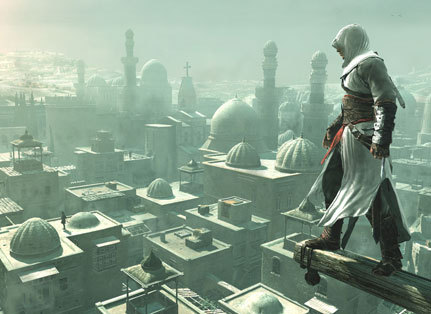
Then there are games like "Assassin's Creed" which put you directly in historical settings with important figures.

Now, since the franchise establishes that there is a sci-fi element to it, and that the whole premise is that history may not be what is written, they cleverly avoid having to stick to historical fact too much. Yet, they use immersion.

In the "Assassin's Creed" games, half of what you hear on the streets of Jerusalem is incomprehensible if you don't speak the language, while in Rome the streets are flooded with shouting in Italian. Even Constantinople has a mix of languages to really set the tone.

The colors used, landmarks, buildings and clothing cement the location. Not to mention the ability to visit historical monuments and climb all over them. Even though the game mucks with historical fact here and there, it really does rely on being grounded in history to provide an enjoyable experience for the player.

But what about games set in a well known time period and location while also using fictional people and places? Look no further than "Red Dead Redemption" and "L.A. Noire." New Austin clearly isn't real, but it felt just as beautiful and weather-beaten as any other part of the West during the Expansion Era of the United States. Even the region of Mexico that John Marston travels to is believable, though not all of Mexico was full of bandits and tyrannical colonels.

Then there's Cole Phelps and his descent into the gritty underbelly of Hollywood. Of course, using real studios was out of the question, but putting fictional ones seamlessly into the iconic Los Angeles landscape was simple enough and downright convincing. Having a shootout in an RKO-esque movie set, car chases through greater LA County streets and searching for clues in back alleys all sold the setting.

The streets of Armadillo are paved with dead gunslingers.
We love going back in time. It's why we go to movies and read books and play video games. The times we really enjoy it, though, are the times when we believe it - the times we're truly convinced we are seeing or experiencing an event from the past.

 Even if something about the game is far fetched, like flying through the Venice skyline on one of Leonardo da Vinci's flying machines, we still feel as if it's Renaissance Italy. Even if you take over the Roman empire as Carthage in "Rome: Total War," you believe it's possible using the historically accurate troops and tools of that time period.

The name of the game, ladies and gentlemen, is immersion. Say, that might actually be a pretty good game title. Anyone want to help me make it?

Wednesday, July 25, 2012

Un-tie the tie-ins

I've played quite a few movie tie-in games in my life, and (surprise) they are generally not very good. I don't think it's the fault of the developers, though, because studios like Beenox, which has created both movie tie-in and original titles, are capable of creating very good games when they aren't tied to films.
I think the so-called curse of movie tie-in games is not so much a curse as it is a failure to recognize the difference in development methods and schedules of movies and video games.
Often, movie tie-in games are expected to begin and end development at or around the same time as the films they are tied to. This production schedule regularly results in game developers having to sacrifice polish and testing in order to ship the product around the same time as the film.
The fact is that video games aren’t created in the same way or within the same time frame that movies are.
This recent movie tie-in game was decent, but not stellar.
Some games are even meant to emulate the film experience so much that a considerable amount of control is taken away from the player in order to show off particularly impressive graphics and scripted scenes.
Video games are not about watching movies from a first-person perspective.
They are about experiencing events, emotions and characters in ways that films cannot allow. They are about giving players the power to create the memorable moments rather than just happen upon them.
Playing cooperatively with someone online and coming together in a moment of tension to overcome a particularly challenging obstacle can be so much more satisfying than walking up to a ledge overlooking a massive battlefield and watching explosions while a battle-weary non-play character spouts lines about how war never changes.
If I want to have a story presented to me, I can read a book. If I want a story presented to me visually and with sound, I can watch a movie. If I want to have an experience that I would otherwise never be able to feel for myself, I can play a video game that places me in a new world and gives me the power to act of my own will within it.
That’s not to say that cinematic games like those in the “Uncharted” series or “Call of Duty” games filled with scripted moments aren’t worth players’ time, or even that they aren’t fun. It’s just that those types of experiences can be had elsewhere in media.
Games give us an opportunity that generations before us could not have imagined. They give us the chance to explore worlds and affect events and individuals in those worlds while creating our own stories.
A game like “Minecraft,” in which there is no narrative background given and no story aside from the one players create for themselves is a good example of the type of freedom games can offer.
Here's a world and some tools. Do whatever you want.
Another game that gives players great narrative power is “The Elder Scrolls V: Skyrim.” The latest chapter in the Elder Scrolls series contains many small stories that players can choose to take part in as well as a main, over-arching storyline, and all of those paths are interesting. But the thing that Bethesda did with the game that makes it so impressive was to offer players the option to follow none of those storylines and simply allow them to explore the land as they see fit. 
Letting people loose in a new world is what makes gaming great.
Certainly, there is a place in the industry for exciting space operas and gritty war stories, and including some interactivity in what would otherwise be a linear story can make for great art, but in the long run, I think that game makers should focus on creating worlds to explore and fill with our own stories rather than guiding players to their end.

Thursday, June 21, 2012

Call of Duty: Black Ops 2 E3 preview


The trailers have been everywhere. It was a big deal when they aired all over TV that the return of "Call of Duty: Black Ops" was imminent in this newest installment of the "Call of Duty" franchise. I won't talk about how somehow Woods survived jumping out a window with a man holding a grenade in his hand, or the crazy Michael Bay-esque cornucopia of explosions that filled television screens. What was interesting was what the commercial didn't show and what gaming press got a taste of at E3 2012.

In the bowels of the Activision pavilion, a demo was shown to display the shiny new "Call of Duty." "Black Ops" developer Treyarch has really worked hard to compete with what Infinity Ward, of "Modern Warfare" fame, has laid down over the last decade. With "Battlefield 3" storming through shelves there's been a lot of worry in the competitive multiplayer shooter bracket as to what can now become the new giant.

"Black Ops" took place in the Vietnam and Cold War era, while "Black Ops 2" seems to have leaped forward into the near future. The pitch a Treyarch spokesman gave was the what-if scenario that of all the world's nations' automated and un-manned technology being turned against them in a full-scale attack.

The setting: Los Angeles. Appropriate for the expo and ironic as the demo showed a demolished skyline, a smouldering Staples Center and a battered freeway. Escorting the president through this hellish glimpse into the future, the player was assaulted by drones running strafing patterns and camouflaged enemies hiding behind freeway walls and broken-down cars.

Luckily for Mason, the player character with the same name as the hero from the original "Black Ops" (relation or coincidence is up for interpretation until more is known), he wields a rifle that fires charged rounds through cover and swats his enemies down.

While the game asked Mason to provide cover for the president and her guard, the spokesman for Treyarch mentioned that it was entirely possible for the player to rappel down and fight alongside the honor-guard as opposed to provide covering fire from above.

"Black Ops 2" depicts a future with quadrupedal war mechs.
After driving through a crowded freeway tunnel full of enemies, Mason and his team enter L.A. proper and begin to fight their way through city streets while drones bomb and strafe from above. That's the least of their worries as boar sized quadruped mechs ram and blast their way through the local forces.

Explosions! Violence! Tiny little RC helicopters that attack the enemies you target from the first-person-perspective! But that's not all! Taking a page from "Battlefield 3's" book, Mason jumps into a hover-jet to provide air support.

It looks like Treyarch has hit everything on the checklist for a current shooter. The most impressive addition to the game was a group of missions where the player can command ground forces to take objectives.

Now, it's hard to describe exactly how this works, but it works almost completely like the mission in the first "Black Ops" where the player positions the team from the Blackbird above. Except instead of a jet thousands of feet above the team, it looks like there's a helicopter. As the mission goes on, mechs or small helicopters can be sent to assist the ground forces. Not only that, but the player can control any of these from the first-person perspective, humans and robots alike. Alternatively, the entire mission can be played from the overwatch perspective.

Unmanned drones are now part of the player's arsenal.

Of course, the shooter fans who mainly buy this franchise may not enjoy this micromanagement. It's a risky move, but it might be what is needed to reinvigorate the shooter franchise by proving this method may work and then incorporating it into future games. Fans of other games like "Total War" or "Company of Heroes" may become interested in a shooter like "Call of Duty" if this works.
Related Posts Plugin for WordPress, Blogger...